

Flat-six engine sound: a bark down low, a wail at 9,000 rpm
Brul is a web app that plays a realistic engine sound through your car’s speakers and follows your throttle. Its Flat-6 is a naturally aspirated boxer six: two flat banks of three cylinders, firing every 120 degrees, with a wail that keeps building to 9,000 rpm.
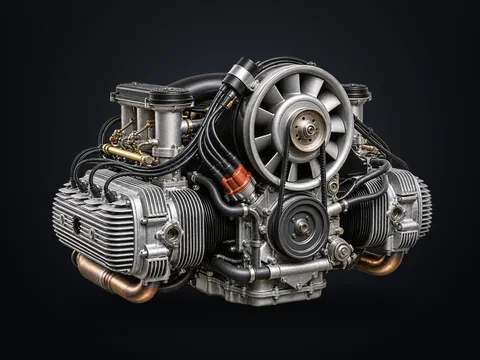
- Layout
- Flat-6 (boxer six), two banks of three, naturally aspirated
- Firing interval
- 120° crank angle, even
- Typical firing order
- 1-6-2-4-3-5
- Main tone
- 3rd order plus boxer half-orders; 6th and 9th up high
- Idle / redline in Brul
- 850 / 9,000 rpm
- In Brul
- Pro engine
What is a flat-six?
A flat-six, or boxer six, has two banks of three cylinders lying flat, opposite each other, on one crankshaft. Like an inline-six it fires every 120 degrees: three pulses per revolution.
The firing order swaps banks on every pulse. Porsche’s flat-sixes fire 1-6-2-4-3-5, so each bank fires every 240 degrees and the whole engine every 120.
Why does a flat-six sound different from an inline-six?
Same firing interval, different plumbing: each bank has its own exhaust manifold, and in Brul’s Flat-6 one bank’s pulses arrive a fraction later than the other’s. That small offset adds half-orders (1.5, 4.5 and 7.5 per revolution) between the clean third, sixth and ninth orders of a six. The result is a harder, raspier edge: the flat-six bark.
High in the revs the character changes. The current naturally aspirated GT flat-six breathes through six individual throttle bodies and revs to 9,000 rpm. In Brul’s Flat-6, peaks on the sixth and ninth orders rise from about 6,100 rpm and take over: the bark turns into a wail.
Which cars made the flat-six sound famous?
Above all the rear-engined sports cars of the Porsche 911 type, especially their naturally aspirated GT versions. Brul’s reference is the 4.0-litre engine of the 911 GT3, with its 9,000 rpm redline. Earlier GT engines revved to about 8,400 rpm.
Brul is not affiliated with or endorsed by any car maker. Names only describe the type of engine.
What does Brul model in the Flat-6?
Brul synthesizes the sound live, cylinder by cylinder. For the Flat-6 that means:
- Six even pulses every 120 degrees, with each bank’s exhaust pulses slightly offset in time: the boxer half-orders.
- Small differences between the cylinders, as in a real engine.
- Shriek peaks on the sixth and ninth orders from 68% of the redline, about 6,100 rpm, so the wail grows as you rev.
- A 9,000 rpm redline, with revs that rise and fall faster than in most Brul engines.
- A lightly muffled exhaust impulse response.
- Crisp, quick bursts of crackle when you lift off from high revs.
Flat-6 vs Flat-4 turbo: two boxers in Brul
| Flat-6 | Flat-4 turbo | |
|---|---|---|
| Cylinders | 6, two banks of three | 4, two banks of two |
| Firing interval | 120°, even | 180°, even |
| Exhaust | Banks slightly offset in time | Unequal-length manifolds: pulses arrive unevenly |
| Induction | Naturally aspirated | Turbo, with whistle and blow-off |
| Character | A bark, then a wail | A burble |
| Idle / redline in Brul | 850 / 9,000 rpm | 800 / 7,000 rpm |
Both fire evenly. The Flat-4 turbo’s burble comes from its unequal exhaust manifolds; its whistle and blow-off come from the turbo.
How do you get the best flat-six sound in Brul?
- Drive mode: Track shifts late, so every gear runs into the 9,000 rpm wail. In Sport the shift points follow your throttle: gentle throttle keeps the bark, full throttle revs into the wail.
- Exhaust: Straight pipe is brighter, rawer and about 2 dB louder, with more crackle. Stock is darker and about 2 dB quieter.
- Pops: in Sport they are subtle by default. Switch on Pops and bangs for the full crackle, or choose Track.
- Top speed: a lower value gives shorter gears, so you reach the wail sooner at normal road speeds.
- The Flat-6 itself, Sport, Track, exhaust choice and pops are part of Brul Pro; top speed is a free setting. Set it up before you drive, leave the phone alone while driving, and keep the volume low enough to hear traffic and sirens.
Listen: Flat-6, Inline-6 and Flat-4 turbo
The same short drive for each: start-up, full throttle through the gears, lift off. Listen for the flat-six’s rasp next to the smooth inline-six, and its wail next to the turbo flat-four’s burble.
Start the Flat-6
Open brul.app on your phone in any car, or in your Tesla’s browser. Try it free now, with every engine unlocked.
Try it freeQuestions
What does a flat-six engine sound like?
Low down it has a hard, slightly raspy bark; high up it turns into a rising wail. In Brul’s Flat-6 the wail builds from about 6,100 rpm to the 9,000 rpm redline.
Is a flat-six the same as a boxer engine?
Almost always. A boxer is a flat engine in which opposite pistons move in and out at the same time, and flat-sixes such as the type in the Porsche 911 are built that way. Brul’s engine list calls it Flat-6, and its four-cylinder boxer is the Flat-4 turbo.
What is the firing order of a flat-six?
Porsche’s flat-sixes use 1-6-2-4-3-5, alternating between the banks: one cylinder every 120 degrees, like an inline-six.
Why do turbo flat-sixes sound more muted than naturally aspirated ones?
The turbine sits in the exhaust, where it damps the pulses and changes the balance of frequencies before the sound reaches the tailpipes. Brul’s Flat-6 is modelled on a naturally aspirated, high-revving engine, so its pulses stay sharp.