

Rotary engine sound: the twin-rotor turbo, brap and all
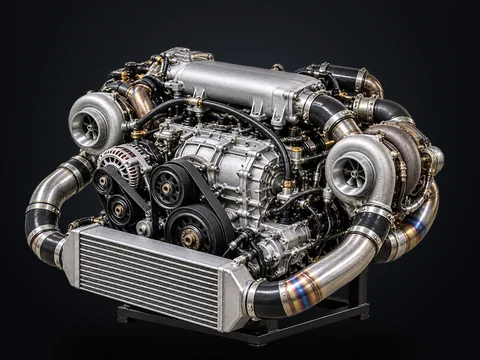
Brul is a web app that plays a realistic engine sound through your car’s own speakers and follows your throttle. Its Rotary turbo is a twin-rotor Wankel with sequential twin turbos: a brap at idle, a buzzing rasp under load and a second turbo that joins above 4,500 rpm.
- Layout
- Twin-rotor Wankel, sequential twin turbos
- Rotors
- 2
- Firing interval
- 180° of shaft rotation (2 pulses per revolution)
- Idle / redline in Brul
- 850 / 8,000 rpm
- In Brul
- Pro engine
What is a rotary engine?
A rotary, or Wankel, engine has rotors instead of pistons. Each three-sided rotor turns inside its housing and drives an eccentric shaft. The rotor turns once for every three turns of the shaft and gives three power pulses per turn, so each rotor fires once per shaft revolution.
With two rotors that makes two pulses per revolution, one every 180°: the same firing rate as a four-cylinder, or 200 pulses a second at 6,000 rpm.
Why does a rotary sound different from a four-cylinder?
Same pulse rate, different pulses. A piston engine’s exhaust valve opens gradually. In a rotary, the exhaust port is uncovered in one go as the rotor’s apex seal sweeps past, so the gas bursts out. Each pulse is sharp and long, and together they make the rotary’s buzzing rasp.
Its exhaust gas also runs much hotter than a piston engine’s, and with a free-flowing exhaust a rotary is known to crackle and bang on downshifts.
What is the rotary brap?
Not every rotary braps: a stock rotary idles with a smoother hum, closer to a six-cylinder. The brap belongs to ported engines, where intake and exhaust ports are briefly open at the same time. Exhaust gas flows back into the intake, so now and then a firing only half burns and the next charge is fuller: brap, brap.
Brul’s Rotary turbo idles with that ported-style brap, built as a half-burnt firing followed by a fuller one rather than as random roughness. Give it throttle and the brap disappears into the rasp.
What do sequential twin turbos sound like?
Sequential twin turbos on a rotary are best known from cars such as the 1992–2002 Mazda RX-7: two rotors of 654 cc and two turbos working in sequence. The first boosts at low and middle revs; around 4,500 rpm the second comes in, with a brief dip in boost at the changeover.
In Brul you hear a second whistle join the first above 4,500 rpm with more than half throttle, announced by a short whoosh and a slight dip.
Car names only describe a type of engine. Brul is not affiliated with or endorsed by any car maker.
What does Brul model in the Rotary turbo?
Brul calculates the sound live, pulse by pulse, through a modelled exhaust: no recordings.
- Two rotors, each firing once per shaft revolution, with an exhaust that opens earlier and harder than in Brul’s piston engines.
- Rotor B slightly weaker than rotor A, which gives a rhythm that repeats once per revolution.
- A buzzing rasp and a scream that grows towards the 8,000 rpm redline.
- Sequential twin turbos with their own whistles, plus a blow-off that flutters about half the time.
- Exhaust pipes that follow the gas temperature, more strongly than in any other Brul engine.
- Sharp, ragged pops on the overrun: more crackle and more big bangs than any other Brul engine.
How do you get the best rotary sound in Brul?
Set it up while parked. Sport, Track, the exhaust choice, pops and Tunnel mode are part of Brul Pro.
- Open brul.app, pick Rotary turbo under Sound of, and choose your own car under Your car.
- Choose Track: it shifts up late, so the revs climb past 4,500 rpm, where the second turbo joins under more than half throttle.
- For the crackle, lift off from high revs with Pops and bangs on; in Track they always are.
- Pick Straight pipe for the rawest rasp, or Stock for a civilised daily sound.
- To share it, park, switch to Simulation and record a 15-second clip.
- Keep the volume low enough to hear traffic and sirens, and don’t touch the phone while driving.
Listen: rotary, four-cylinder and inline-six
The 4-cylinder turbo shares the rotary’s pulse rate, not its pulses. A stock rotary is said to idle with a hum like a six-cylinder’s, closer to the Inline-6; porting is what turns it into a brap.
Put a rotary in your car
Open brul.app on your phone in any car, over Bluetooth or a cable, or in your Tesla’s browser. No subscription, up to 5 devices.
Start the engineQuestions
Does a rotary engine sound like a four-cylinder?
A twin-rotor fires at the same rate, two pulses per revolution, but its exhaust port opens all at once. Each pulse is sharper and longer, which gives the rotary its buzzing rasp.
How high does a rotary rev?
In the 1992–2002 Mazda RX-7 the rev counter ran to 9,000 rpm, with the red zone from 7,000. Brul’s Rotary turbo idles at 850 rpm, revs to an 8,000 rpm redline and climbs and falls faster than Brul’s other turbo engines.
Can I try the Rotary turbo for free?
You can try it: the first 5 minutes of Brul in Simulation are Pro, with every engine, and Drive adds a 10-minute test drive. The Rotary turbo comes with Brul Pro, €9.99 once.